
Corpus: AI bid/no-go and SOQ drafts for engineering firms
Corpus by SalemWise is page-cited AI for civil, structural, geotechnical, environmental, surveying and mining firms. It reads your project archive, suggests bid/no-go scores on a new RFQ with each scored factor linked to its sources, drafts the SOQ with every sentence cited to the page, and builds the fee with the math done by code. If the archive does not hold the answer, it says “Nothing on file.”
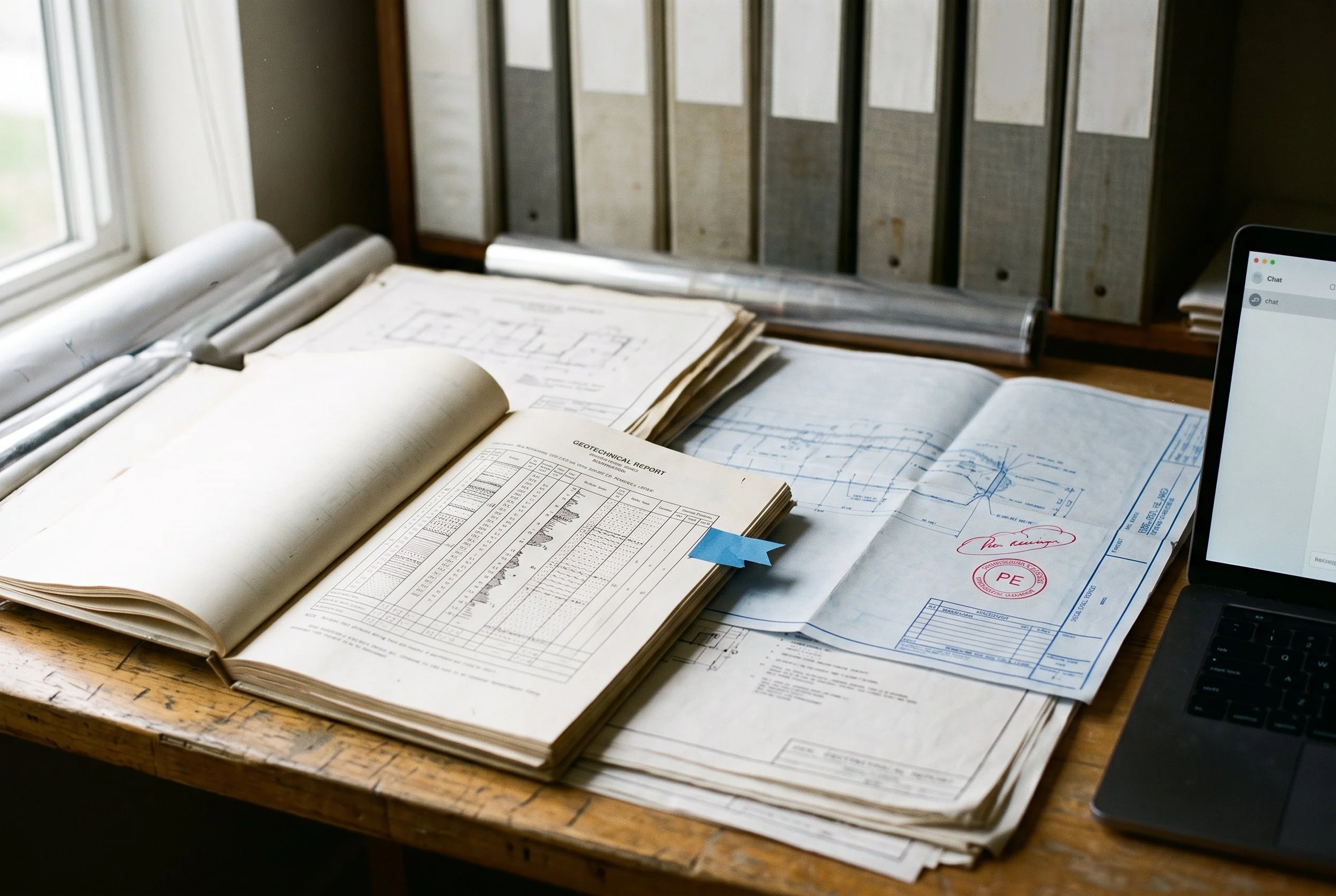
Most proposal AI reuses your old proposals. Corpus reads the projects themselves: geotech reports, calc packages, specs, bid tabs and drawings, and every sentence cites the page it came from.
A fictional sample firm’s archive, built from real public engineering documents: DOT plan sets, geotech reports, bid tabs, specs and real public RFQs.
Run your next RFQ through Corpus.
One RFQ, four jobs, all answered from your own work.
Bid or pass
A new RFQ arrives. Corpus reads it and suggests go / no-go scores against your past projects: similar scope, client, location and discipline.
- Each suggested score linked to the pages behind it
- Fit, relationship and capacity stay your call; the verdict comes when your team has scored all nine
Draft the SOQ
Corpus pulls your most relevant projects and drafts the SOQ sections from them.
- Every sentence cited to the document and page it came from
- A draft your team edits, reviews and signs off
Price it and paper it
Build a cost-plus-fixed-fee estimate; the demo follows WSDOT’s method. The fee math is done by code, not by the AI.
- A fee build you can check line by line
- A draft contract to start from: a draft, not legal advice
Who sees what
Restricted projects stay restricted. Access is trimmed by role before search runs.
- Nobody gets an answer drawn from a file they cannot open
- The same rule applies to the SOQ and fee tools
What watertightness testing standard and leakage limit apply to the containment concrete structures?
ACI 350.1, Testing Reinforced Concrete Structures for Watertightness. The maximum leakage allowed in the final 24-hour test is 0.05 percent of the test volume [1]
What liner thickness did we carry for the Harborview digester dome?
Every answer shows its page. No page, no answer.
- Engineers ask plain questions of the archive: past designs, specs, geotech findings, what the client asked for last time.
- Each answer is cited to the document and page, so it can be opened and checked.
- If it is not in the archive, Corpus says “Nothing on file” instead of guessing.
Both questions are on the live demo: a fictional sample firm, real public documents.
Your files stay where you decide.
Your hardware or ours
Corpus runs on a local NVIDIA GPU on your network, or on ours. It uses an open-weight model and no outside AI service. On-prem, your files never leave your office.
Access trimmed by role
Permissions are applied before search, not after. Restricted projects stay restricted: litigation holds and walled-off jobs are removed before search runs, and answers only draw on files the person asking is allowed to open.
Connected at setup
In the full deployment we connect Corpus to your archive where it lives: network drive, SharePoint, ProjectWise or whatever you use. It runs in the browser, and we connect Microsoft Teams during setup if you want it there. We do the integration work inside your network; your IT lead grants access and signs off.
No customer logos yet. Here is what you can check today.
The live demo
57 public engineering documents, filed under a fictional sample firm: DOT plan sets, geotech reports, specs, bid tabs and real public RFQs. Ask it anything.
Every page citation
Click a source and the cited page opens with the passage highlighted.
The refusals
Ask about work that is not in the archive and it says “Nothing on file”.
The permission trim
Switch from the engineer to the principal: the restricted project appears only for the person allowed to open it.
The fee math
Done by code, line by line, not by the AI.
The price
$5,000 fixed for the pilot, credited toward setup. You judge it on your own RFQ.
Two steps. The first one is credited.
- We load a copy of a slice of your project PDFs, for example the last 2–3 years
- We run your next real RFQ through Corpus: go/no-go, SOQ draft, fee build
- You judge it on your own pursuit
- No integration work in the pilot
The $5,000 is credited toward full deployment if you continue.
- Deployed on your archive where it lives: we connect to your network drive, SharePoint or ProjectWise as part of setup
- In the browser; Microsoft Teams connected during setup
- Runs on your own hardware or ours
- Live in 6–8 weeks. No per-user fees
Straight answers to what firms ask first.
What is Corpus?
Corpus by SalemWise is page-cited AI for civil, structural, geotechnical, environmental, surveying and mining firms. It suggests bid/no-go scores on a new RFQ, drafts SOQ sections and builds the fee from the firm’s own past projects, citing the document and page for every claim.
How much does Corpus cost?
A $5,000 fixed-price pilot on one real pursuit (about 2–3 weeks), credited toward setup. Full deployment is from $21,000 setup, then $1,500–$2,000/mo, with no per-user fees.
We already use a proposal tool. Why add Corpus?
Keep it. Proposal tools are built around your past proposals, photos and resumes. Corpus works one layer down: it reads the project files themselves (geotech reports, calc packages, specs, bid tabs and drawings) and gives your proposal team cited facts and a first SOQ draft to carry into the tool you already use.
We already have Microsoft 365 Copilot. Isn’t that enough?
Copilot is a strong general assistant. Corpus answers from your archive, with document-and-page citations, and says “Nothing on file” when the answer is not there. Firms can keep both.
Our archive is on a network drive, not SharePoint.
That is fine. The full deployment connects to the archive where it lives, including a network drive. The pilot does not need any connection: it uses a copy of a slice of your project PDFs.
What does the $5,000 pilot include?
A fixed price and about 2–3 weeks. We load a copy of a slice of your project PDFs, for example the last 2–3 years, and run the RFQ you are pursuing now through Corpus: a go / no-go scorecard with suggested scores linked to their sources, an SOQ draft with every sentence cited to the page, and a fee build with the fee math done by code. Your team also gets a hands-on session on its own archive. There are no integrations and no production rollout, and the $5,000 is credited toward full deployment if you continue.
Where do our files go?
On your hardware, Corpus runs on a local NVIDIA GPU on your network and your files stay in your office. Hosted with us, they are processed on our own servers. Either way it uses an open-weight model and nothing goes to a public AI API. In the pilot, your files are never used to train or fine-tune a model; in full deployment, only if you agree in writing. We don't have a SOC 2 report, which is one reason the default is your own hardware.
What if Corpus gets something wrong?
Every answer cites the document and page, so your engineer opens the source and checks it in seconds. If the archive does not hold the answer, Corpus says “Nothing on file” instead of guessing. The fee math is done by code, not by the model, and the SOQ is a draft your team edits and signs off. Only a principal can approve a fee, and editing the fee clears the approval. Corpus does not check hydraulic, structural or other engineering calculations; your engineers do.
How much IT time does it take?
The pilot needs three things from your side: pick the folders, get us one copy, and a 30-minute kickoff. Nothing connects to your systems, and nothing is installed unless you choose to run the pilot on a GPU box on your network. In the full deployment we build the connection to your network drive, SharePoint or ProjectWise ourselves, inside your network. Your IT lead grants access and reviews what we set up.
Can it read our scanned drawings?
Scanned sheets are OCR’d as part of setup, so they can be searched and cited like the rest of the archive. For the pilot, text-searchable PDFs work best; tell us about the scans you care about and we will plan around them.
Why not just use Deltek Dela?
Dela is good at what lives in Vantagepoint: projects, clients, staff and financials. It does not read the drawings, calc packages and geotech reports on your file share. Corpus does, with every answer cited to the page. Firms can keep both.
Is $21,000 worth it?
Honest answer: that is what the pilot is for. Run one real pursuit through Corpus for $5,000, then decide. The $5,000 is credited toward setup if you continue, and there are no per-user fees.
Run your next RFQ through Corpus.
A fixed-price pilot on a real pursuit, judged by your team. $5,000, credited toward full deployment.